
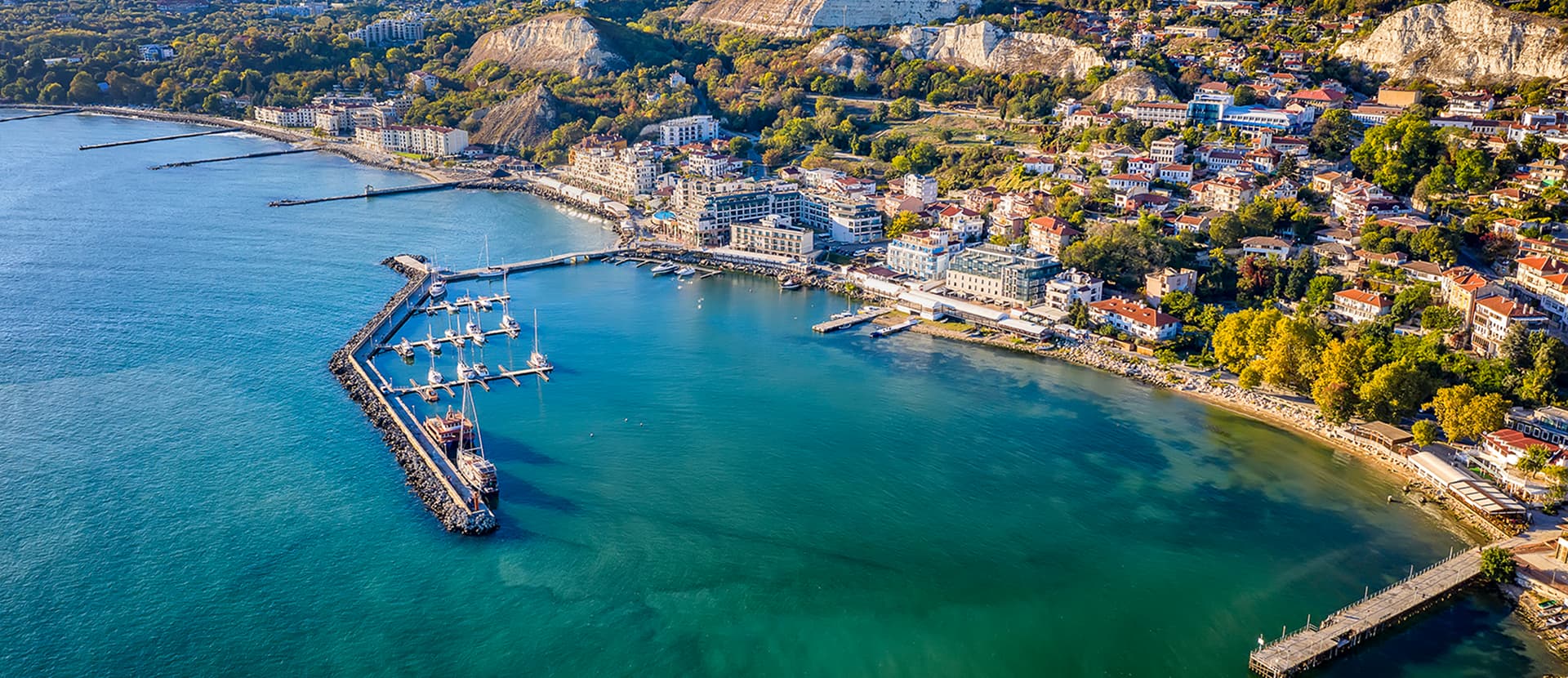
Six hundred metres along the seafront from our gate stands one of the strangest places in Bulgaria: a small architectural ensemble built by a Romanian queen between two world wars, left to nature for eighty years, and now one of the best-kept botanical gardens in the Balkans. May is the month when Queen Marie's Palace shows itself most fully — because that is when everything that was meant to bloom blooms.
This is not a "top-10 attractions" guide. It is a practical look behind the curtain from someone who walks the place several times a week and has done so for five years. What to look at, what to skip, when to go, and why May beats July.
Why May specifically
The botanical garden is divided into themed zones, each with its own peak. April is still grey and brown. By June the rose garden has dropped, the lilies are over, and the summer rhythm of the lavender begins. July and August are hot and dry — the only attractions that stay open are the ones that survive 30 °C. September brings part of the colour back with late hollyhocks and a second-flush of roses, but not the intensity of May.
May is the only month when everything overlaps: the rose garden starts in mid-month, the cacti hit their first full bloom, the lilies are still working, the irises hold until the 20th. The first week of May is still cool, but after the 10th the temperatures become pleasant for long stretches on the terraces. A bonus: the charter groups have not yet started — this is the last week to see the Palace almost empty.
A short history — Marie, 1924, "the Quiet Nest"
Balchik was under Romanian jurisdiction from 1913 to 1940 — a result of the Balkan Wars. Queen Marie of Romania — a granddaughter of Queen Victoria — visited the town in 1921 and fell for it. Construction of a summer residence began in 1924; the main parts were completed by 1936. The name she gave the place was "the Quiet Nest" — Cuibul Liniștit — because it was where she came to hide from the court in Bucharest.
The architecture is a particular blend: Islamic minarets (she liked the Eastern aesthetic), a Christian chapel (Stella Maris), Italian terraces (for the light), an English garden (an inheritance from her grandmother). Walking the grounds you pass through four or five distinct stylistic periods within 200 metres. Few places in Europe do that.
After her death in 1938, Marie's heart was placed in Stella Maris — the small chapel by the sea. In 1940, when Southern Dobruja returned to Bulgaria, the Romanian government removed the heart and returned it home. Different sources name different current locations — Bran, Pelișor, the National History Museum in Bucharest. It is a question even Romanian historians answer with hesitation.
The cactus collection
One of the more unusual things about Balchik: here, on the Black Sea coast, sits one of the largest cactus collections in Europe. More than 250 species, laid out in terraces down the slope above the sea. Why here? Because the harsh sea-wind climate is closer to Mexico than you might think — salt air, rocky ground, little fertile soil.
The collection is at its best from 11 am to 1 pm, when the sun stands high and casts long shadows from the spines. Start at the top — on the path above the collection — and walk slowly down. One of the pleasures is watching the species become stranger as you descend: you start with garden-shop cacti and end up with shapes that look more like rock formations than plants.
The rose garden — 250 cultivars
The rose garden is the central spine of the grounds. From the main entrance an 80-metre path runs between formal beds, a different cultivar in each. By mid-May about 60 percent of the roses are open; by the end of May the bloom is full.
Among the cultivars are several English roses from David Austin, some very old French ones (a few date to the previous century), and a handful bred at the Palace itself. Maintenance is serious — pruning every day, watering morning and evening, mulching once a week. So you will see gardeners working during your walk; they do not hide, because the work is part of the garden's life.
The Silver Well
Halfway down the path from the rose garden to the sea there is a small stone well, and there are usually a few people gathered around it. It is not a major attraction — no sign, no notice. But the locals know the story: by one tale, the water brings luck in love if you drink it with your beloved. By another, Marie used to come in the morning to wash her face with "water touched by the sun".
A small, quiet moment. Spend five minutes there even if you don't drink anything.
Stella Maris and the story of Marie's heart
The Stella Maris chapel is tiny — there is room inside for about twelve people at once. The architecture is minimal, with a gilded iconostasis, a wooden ceiling, and a single stained-glass window facing north. It looks straight at the sea and on clear days the late-afternoon light through the glass turns the chapel walls gold for about thirty seconds before sunset.
Between 1938 and 1940, Marie's heart was kept here in a small silver casket. Local people tell that when the heart was carried out in 1940, many residents of Balchik came not as spectators but as witnesses. It is a strange, quiet moment in regional Bulgarian history.
The Tea House — afternoon tea with a view
The Tea House works on the terraces near the Palace's main building. The menu is light: teas, sandwiches, home-made cakes, a small ice-cream selection. Prices are reasonable (around 5–8 BGN for a tea). The view from the terraces takes in the bay, the sea, and the seafront promenade.
The best slot is afternoon tea between 4:30 and 5:30 pm. The light is golden, the tour groups are leaving, and the staff have time for you. One of the quiet pleasures of Balchik.
How to walk it well
The ideal sequence for a couple who wants to see everything without rushing is this. Leave Cossara around 9 am. Enter through the main gate — not the beach gate, which is steeper and tires you before you start. Walk down through the rose garden, past the Silver Well, and out at Stella Maris. Sit on the seafront benches there for twenty minutes. Then climb back up to the cactus collection — best around 11 to 12 noon. By 1 pm you are in the Tea House for a light lunch.
Later in the afternoon, if you have the energy, stop in the small museum inside the central building — Marie's original furniture, her correspondence, photographs. Otherwise drift back to Cossara around 2 pm, lunch on the restaurant terrace, and rest until dinner.
The route from Cossara and back
600 metres along the seafront promenade — about 8–10 minutes on foot. Walk it even if you have a car. The promenade passes a small jetty with boats, a café terrace (open from May), and the old town wall. The walk is worth eight minutes on its own.
The return in the afternoon is easier the same way — there is only one mild climb. If you are tired, take a taxi from the Palace gate — about 5 BGN to Cossara.
One useful note
The Palace has wi-fi but it is weak. If you plan to lunch at the Tea House and work — bring a book instead of a laptop. This is a place that resists technology.
Practical information — opening hours, prices, events — is on the Palace's official site. If anything in this article disagrees with theirs, trust theirs.
← Back to News